528 Hz: What the Evidence Actually Supports
528 Hz carries some of the biggest claims in frequency music. We separate the modern Solfeggio tone from the marketing and cite what actually holds up.
Of all the numbers in frequency music, 528 Hz carries the heaviest freight. It fills playlists, apps, and thumbnails wrapped in the grandest promises in the genre, and it is probably the single most oversold tone in it. Strip that language away, though, and something much smaller is left: a specific pitch, close to the C above middle C, and a piece of relatively recent history.
That leaves two separable questions, and they do not have the same kind of answer. The first is about the tone itself: where the number comes from, and whether a given file is even centered on it. That is history and measurement. The second is about what the tone does. That is evidence, and the evidence is far more modest than the label implies. Most channels collapse the two questions into one confident promise. They are worth pulling apart.
What the claim actually is
528 Hz belongs to the modern Solfeggio scale, a set of frequencies popularized in the 1990s and frequently presented as if it were ancient (HowStuffWorks). Around that scale a large body of claims has grown: that 528 Hz repairs cells or DNA, that it is a healing “miracle” tone, that it is the frequency of “love.” These are the claims that sell the number, and they have no scientific basis, and we do not make them. Naming them plainly is the fastest way to set them aside.
What remains after they are set aside is unglamorous and accurate. 528 Hz is a pitch. It can be generated, played, and measured. Whether it deserves the weight placed on it is a separate question from whether a track is actually tuned to it, and only one of those can be settled with an instrument.
What the science actually shows
Here the honest answer has to be tiered, because the evidence is not uniform.
At the strongest tier, there is no direct, peer-reviewed trial showing that 528 Hz specifically does what the marketing claims. A search for a controlled study of this exact frequency comes up empty, and the pseudoscience read of the Solfeggio set is not a fringe opinion but the mainstream one (HowStuffWorks). Any channel that tells you 528 Hz has been “proven” to do what the marketing promises is describing something that does not exist in the literature.
At a weaker but genuine tier, sound in general, including low and steady sound, is associated with relaxation and comfort. The closest real literature is vibroacoustic therapy, which studies low-frequency sound and vibration, typically in the 20 to 120 Hz band, in relaxation and pain contexts (vibroacoustic therapy scoping review, 2022). Frequency-music channels often file 528 Hz under that same umbrella. But that studied band sits well below 528 Hz, and the research describes a broad response to low-frequency sound, not a property of any single tone. It supplies context, not validation for 528 Hz.
So the tiers, stated plainly: no support for the specific claims, and some support for the ordinary idea that calm, steady sound helps people relax. Those are very different statements, and the marketing depends on blurring them together.
What we measured
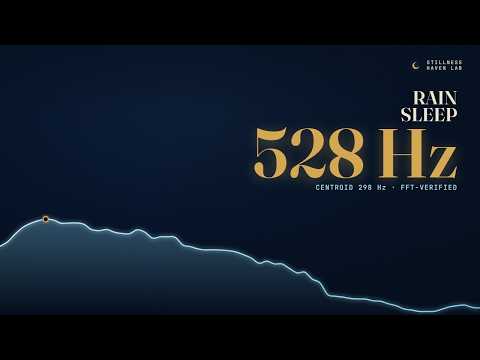
This is where our own work has to hold to the same standard we apply to everyone else. This particular session is an eight-hour sleep-with-rain composition built around the 528 Hz reference, and the honest thing to publish is not a promise but a number.
For every session we release, we report the spectral centroid, the center of mass of the sound’s energy across the audible band. It is the one figure that is not a matter of opinion. It tells you where the weight of the track actually sits, which for a full sleep mix layered with rain is a very different thing from a single bare tone. “528 Hz” is a label. The centroid is verifiable. Publishing it lets you check the sound against its description instead of taking the description on trust.
That distinction, label versus verifiable, is the whole point. A number printed on a thumbnail is a claim. A centroid measured from the file is evidence. We would rather hand you the evidence and let the label stand or fall against it.
The honest limits
None of this makes 528 Hz useless, and it would be just as dishonest to overcorrect into that claim. Many people find a warm, low, rain-layered session genuinely easy to fall asleep to, and the general relaxation literature is consistent with that experience (vibroacoustic therapy scoping review, 2022). Steady sound can also mask the sudden noises that fragment sleep. Those are real, if modest, benefits.
What the number cannot do is carry the weight of the bigger story. There is no evidence that 528 Hz affects a medical condition or does anything a neighboring pitch would not (HowStuffWorks). If a session helps you sleep, it is almost certainly working through ordinary, well-understood routes, comfort, masking, and routine, not a special property of one frequency. Keeping that boundary visible is the difference between a sound you can trust and a sound you have simply been sold.
Verify it yourself
You do not have to take our word for any of this, and you should not take a thumbnail’s word either. Two checks are within reach of anyone.
For the tone, drop any 528 Hz track into a free spectrum analyser and look at where its energy actually sits. Many files sold under a Solfeggio number are not centered where the label promises, and the analyser will show you in seconds. For the claim, treat any promise that the tone does something to your body as a cue to ask for a citation: a specific, findable study of that specific frequency. When none appears, you have learned exactly the thing the marketing was counting on you not to check.
The label and the measurement should agree, and the claim and the evidence should agree. When they do not, the gap is the useful part, and it takes less time to find than reading this paragraph did.
Not medical advice. These sessions are made to support relaxation and general wellness, not to treat any medical condition.
 Listen · FFT-verified session 528 Hz: What the Evidence Actually Supports Watch on YouTube →