40 Hz Gamma for Focus: A Map of the Evidence
40 Hz gamma binaural has the strongest research base of any binaural claim, and it is still emerging. What the studies show, what they do not, and why headphones matter.
Most binaural-beat claims thin out the moment you ask for a citation. Forty hertz is the exception. Of every frequency sold with the promise that it will change how your brain works, the 40 Hz gamma binaural beat is the one with an actual stack of peer-reviewed studies behind it, which makes it the most interesting case we cover and the easiest to oversell.
That combination is exactly why it deserves careful reporting. There is real signal here, enough to take the idea seriously. There is also a clear line where the evidence stops, and a second line where a famous piece of research gets borrowed to say things it never said. This post maps both, so you can tell the strong part of the claim from the part that is still guessing.
What the claim actually is
A binaural beat is a perceptual trick, not a sound in the file. Play one steady pure tone into your left ear and a slightly higher one into your right, and your auditory system reconstructs a third, phantom pulse at the difference between them. Feed it 200 Hz on the left and 240 Hz on the right, and the beat you sense is 40 Hz, even though no 40 Hz tone was ever recorded.
The 40 Hz figure matters because it sits in the gamma band, the fastest of the common brainwave ranges, which shows up in the literature alongside attention and working memory. The focus claim, stated plainly, is that presenting a 40 Hz beat may nudge the brain toward that gamma activity and, with it, toward a more attentive state. It is a specific, testable proposal, not a mood or a vibe. And because it depends entirely on each ear hearing a different tone, it only exists over stereo headphones.
What the science actually shows
Here the honest answer comes in tiers, because the studies do not all say the same thing.
The strongest single result is a training study in which 40 Hz binaural beats improved people’s ability to catch a second target in a rapid stream, a well-studied lapse called the attentional blink (Scientific Reports, 2020). That is a clean, task-based measure of attention moving in the predicted direction. A later study on gamma-frequency binaural beats reported effects on both attention and anxiety, extending the picture beyond a single lab task (Current Psychology, 2023). And a 2018 study on gamma entrainment frequency reported effects on mood, memory, and cognition as well, which is why 40 Hz keeps surfacing in focus playlists rather than the dozens of other numbers people have tried.
Taken together, that is a genuinely stronger base than any other binaural frequency can point to. It is not, however, a closed case. At least one placebo-controlled study found no significant difference in memory performance between the 40 Hz condition and its control. When a carefully controlled trial comes back null, the honest word for the whole body of work is emerging, not settled. The effect appears real in several designs and absent in at least one, and the mechanism behind it is still being argued.
What we measured
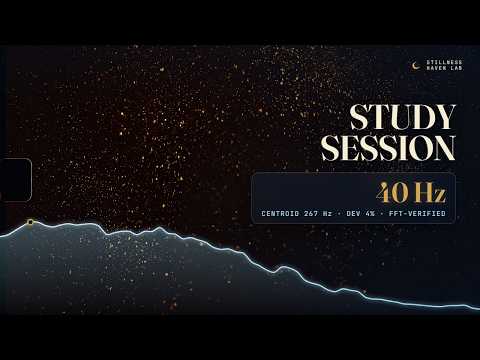
We do not use recordings for the beat itself, because a binaural effect has to be built from two mathematically exact carriers. This session places a 200 Hz pure tone in the left channel and a 240 Hz pure tone in the right. The difference, and therefore the beat your brain reconstructs, is exactly 40 Hz. We hold the carriers at a subtle -22 dB so they sit under the ambient bed rather than dominating it, which is where overnight and long-session comfort lives.
The transparency point is the one competitors tend to hide: the 40 Hz is not present in the audio. It is a differential your auditory system computes from the left-right gap, which is exactly why binaural beats require stereo headphones. Over a single speaker, or with both channels summed to mono, the two tones mix in the air before they reach either ear and the beat never forms. When we verify a session, we check the spectrum for those two carriers, 200 Hz and 240 Hz, sitting 40 Hz apart at the intended level. That is the receipt. Everything above it is research; this part is just measurement.
The honest limits
Three limits belong on the label.
First, the placebo-controlled null result above is not a footnote. It means an attentive, well-designed study looked for the memory benefit and did not find it, so anyone promising a guaranteed cognitive boost is ahead of the evidence.
Second, the studies that do show effects use varied tasks, small samples, and short exposures. A benefit on an attentional-blink task in a lab does not automatically transfer to a two-hour work block at your desk, and the literature has not established that it does.
Third, and most important, is a boundary people cross constantly. The claim that a 40 Hz audio track can slow, prevent, or treat Alzheimer’s disease has no support in the binaural-beat literature, and we do not make it. The widely shared MIT research on 40 Hz and Alzheimer’s used flickering light and clicking sound, sensory stimulation delivered to the visual and auditory systems, not binaural beats over headphones. That is a different delivery method studying a different question, and it is not evidence for an audio focus session. Nothing here is a claim about any disease.
Verify it yourself
You do not have to trust our description of the spectrum, and you should not trust anyone’s. There are two checks, and both take under a minute.
The first is the measurement. Drop any 40 Hz binaural track into a free spectrum analyser and look at each channel on its own. You should see one clean tone in the left channel and one in the right, separated by 40 Hz, near 200 Hz on our session. A file that shows the same content in both ears, or a literal 40 Hz tone printed into the audio, is not a binaural beat at all, whatever the title says.
The second is perceptual and even simpler. Put on stereo headphones, then take one ear off. The beat should soften or disappear, because the effect only exists when each ear receives its own carrier. If a track sounds identical on a mono speaker, the binaural mechanism is not doing anything, and you have learned that in the time it takes to lift a headphone.
The claim and the signal should agree. When they do, you can decide for yourself whether the focus follows, tested on real work rather than on a promise.
Not medical advice. These sessions support focus, relaxation, and general wellness, and are not a treatment for Alzheimer’s disease or any medical condition.
 Listen · FFT-verified session 40 Hz Gamma for Focus: A Map of the Evidence Watch on YouTube →